Dumpster rental terms are the words on every quote: a cubic yard measures container volume, tonnage measures weight, and an overage fee bills weight above the included tons. At 904 Dumpster, a 15-yard includes 1.5 tons for $349, and each extra ton in Duval County costs $75.
Dumpster rental terms make up the vocabulary that appears on every quote, invoice, and delivery confirmation, and most of the confusion about dumpster rental pricing comes from three words: cubic yard, ton, and overage. This glossary defines more than 30 terms in plain English, grouped by topic, and uses 904 Dumpster's actual numbers wherever a term applies to how we work. Where a term is a general industry word, the definition says so.
What Are the Most Common Dumpster Rental Terms?
The six terms that decide most quotes are cubic yard, tonnage, included tons, overage, rental period, and flat rate. A cubic yard measures volume, a ton measures weight, included tons is the weight covered by the base price, and overage is the per-ton charge above it. Rental period and flat rate set the timeline and the price.
| Term | Plain-English Meaning | 904 Dumpster Example |
|---|---|---|
| Cubic yard | Volume: 3 ft by 3 ft by 3 ft | A 20-yard holds 20 cubic yards |
| Tonnage | Weight, measured in tons of 2,000 lbs | A 15-yard includes 1.5 tons |
| Included tons | Weight covered by the base price | 10-yard: 1 ton, 20-yard: 2 tons |
| Overage fee | Charge for weight above included tons | $75 per ton in Duval County |
| Rental period | Days the container stays on site | 3 days (10-yard), 5 days (15 and 20-yard) |
| Flat rate | One price covering delivery, pickup, and disposal | $299, $349, or $399 in Duval County |
The sections below cover these dumpster rental terms and 25 more, starting with the roll off dumpster definition. Each definition is short enough to quote on its own.
Dumpster Rental Glossary: Containers and Sizes
Roll-Off
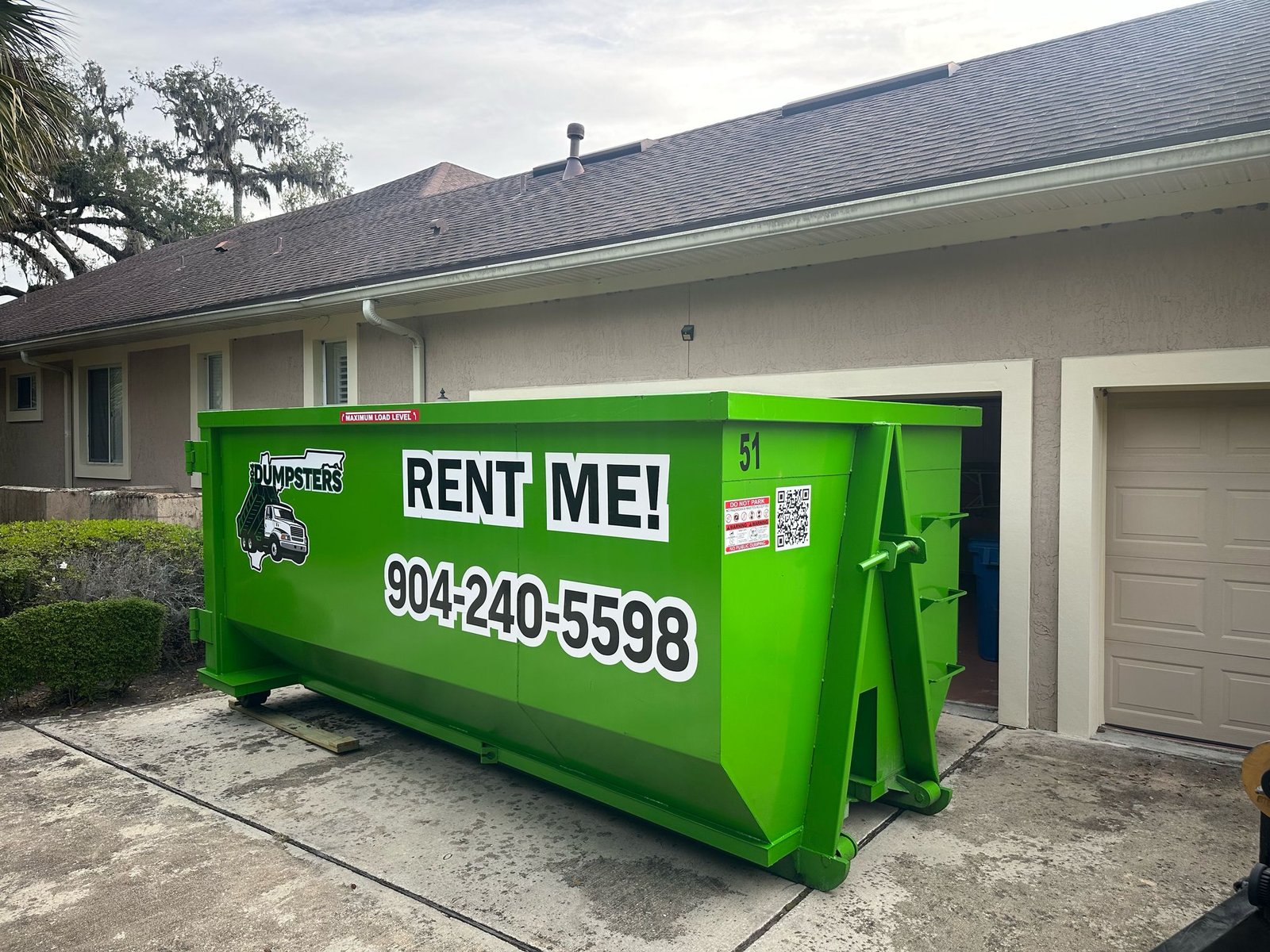
The roll off dumpster definition is simple: a roll-off is a large open-top steel container that a truck slides on and off its frame on rails, which is why the truck can drop it in a driveway and haul it away full. It is the standard container for home cleanouts, renovations, and construction jobs. See the general waste container overview for how roll-offs compare with other bin types.
Open-Top
Open-top means the container has no lid, so you can toss debris in from above. All 904 Dumpster containers are open-top roll-offs. The open top is also why a container should be loaded level and not heaped above the rim.
Swing Door
A swing door, also called a rear door or barn door, is a hinged door on one end of the container. It lets you walk in with a wheelbarrow, dolly, or heavy items instead of lifting them over the wall. The door must be latched closed before the truck hauls the container.
Cubic Yard
A cubic yard is a volume measure equal to a cube 3 feet on each side, or 27 cubic feet. Dumpster sizes are named by it: a 10-yard container holds 10 cubic yards, a 15-yard holds 15, and a 20-yard holds 20. Volume says how much space you have, not how much weight you may load.
Yd and CY
Yd and cy are the two common abbreviations for cubic yard, so "20 yd" and "20 cy" both mean a 20-cubic-yard container. You will see them on quotes and spec sheets. The labels "20-yard dumpster" and "20 yard roll off" mean the same thing as well.
Fill Line
A fill line is the maximum height to which a container may be loaded. The general industry rule is that debris should not rise above the top rail of the container, because an overfilled load cannot be hauled safely or legally. 904 Dumpster does not publish a separate fill-line policy, so confirm the rule for your job with the hauler before loading.
Explore Our Services
Dumpster Rental Glossary: Weight and Fees
Tonnage
Tonnage is the weight of the debris in tons, where one ton is 2,000 pounds. It is measured at the landfill scale, not estimated by volume. Heavy debris such as concrete reaches the weight limit long before the container looks full. Our weight limits and tonnage guide has material-by-material numbers.
Included Tons
Included tons are the weight already covered by the base price. At 904 Dumpster, a 10-yard includes 1 ton, a 15-yard includes 1.5 tons, and a 20-yard includes 2 tons. Weight under the allowance costs nothing extra, and unused tons do not roll over or earn a refund.
Overage
Overage is the charge for debris weight above the included tons, billed per additional ton. In Duval County, 904 Dumpster bills $75 per extra ton. Our Clay, St. Johns, Nassau, and St. Augustine price list shows $100 per extra ton. Call (904) 240-5598 to confirm how a partial ton is billed.
Overage Fee
Overage fee is the dollar amount that results from overage, and it is the most searched billing term in this glossary. Example: a Duval County 15-yard that weighs 2.5 tons carries 1 ton of overage, so the overage fee is $75. Choosing a larger size or keeping heavy material separate avoids it.
Tipping Fee
A tipping fee is what a landfill or transfer station charges per ton to accept ("tip") a load of waste. It is a general industry term. At 904 Dumpster, disposal at Trail Ridge Landfill is built into the flat rate up to the included tons, so you do not see a separate tipping fee line.
Scale Ticket
A scale ticket is the weigh slip a landfill scale produces for a load, showing the gross, empty, and net weight of the truck and container. It is the record that tonnage and overage are based on. If you disagree with a weight, ask the hauler for the ticket.
Flat Rate
A flat rate is one fixed price that covers delivery, pickup, disposal, and a set rental period. At 904 Dumpster, flat rates in Duval County are $299, $349, and $399, with no fuel surcharge or environmental fee. Only extra weight or extra days change the total.
Pay by Weight
Pay by weight is a pricing model where the bill is based on the tons actually hauled, with no weight allowance bundled in. It is common for heavy debris and for some commercial contracts. It differs from a flat rate, which includes a set number of tons. Our pricing models guide compares the two.
Heavy Material
Heavy material means dense debris such as concrete, brick, asphalt, dirt, and roofing shingles. A small volume of it can use up the whole weight allowance. Of all dumpster rental terms, weight words cause the most surprise bills. Heavy loads are best planned by weight, because a 10-yard includes only 1 ton and concrete is far denser than household trash. Ask us before loading, at (904) 240-5598.
Dumpster Rental Glossary: Rental Period and Delivery
Rental Period
The rental period is the number of days the container stays at your site before pickup. For 904 Dumpster it is 3 days for a 10-yard and 5 days for a 15-yard or 20-yard. Plan your loading around that window from the day the container arrives.
Extension
An extension is extra rental time beyond the included period. 904 Dumpster charges $15 per extra day. A 15-yard kept 8 days instead of 5 adds 3 days, or $45. Longer projects can compare daily extensions with a swap plan, covered in our monthly rental cost guide.
Swap or Haul
A swap is when the truck removes your full container and sets down an empty one in the same visit, so loading can continue without a gap. A haul is a plain pickup with no replacement. Swaps are how a project that needs more than 20 cubic yards is handled.
Delivery Window
A delivery window is the block of time in which the truck is expected to arrive, as opposed to an exact minute. Keep the placement area clear for the whole window, and confirm the window with dispatch when you schedule.
Same-Day Delivery
Same-day delivery means the container arrives on the day you order. At 904 Dumpster it is available on orders placed before noon, Monday through Saturday, at the same flat rate as scheduled delivery. For orders after noon, call (904) 240-5598 to confirm the earliest delivery day.
Placement
Placement is where on your property the container is set down. A flat, clear spot with room for the truck and overhead clearance works best, and a 20-yard is 14 feet long and 5.8 feet tall. A driveway is the most common spot, and no permit is needed on private property.
Driveway Protection Boards
Driveway protection boards are wood boards or plywood laid under the container's steel rails so they spread weight and reduce scratches or dents on asphalt and concrete. Boards are a common precaution for a loaded container. Ask the hauler about driveway protection when you book.
You Might Also Read
Dumpster Rental Glossary: Materials and Disposal
C&D Debris
C&D debris is construction and demolition debris: lumber, drywall, roofing, flooring, tile, cabinets, and concrete from building, remodeling, or tearing down structures. The EPA's guidance on construction and demolition materials is the standard federal reference. Our construction dumpster service is built around it.
MSW
MSW is municipal solid waste, the everyday trash from homes and businesses: packaging, furniture, clothing, and household items. A garage cleanout or household load is mostly MSW. MSW is typically lighter per cubic yard than C&D debris.
Prohibited Items
Prohibited items are materials a hauler cannot put in a roll-off, usually hazardous waste, paint and chemicals, batteries, tires, and appliances with refrigerants. They need separate handling. Check the what cannot go in a dumpster guide before loading, and call if an item is not listed.
Landfill
A landfill is the engineered disposal site where non-recyclable debris is buried and weighed in. 904 Dumpster disposes of loads at Trail Ridge Landfill, and the Florida Department of Environmental Protection regulates solid waste facilities in the state.
Dumpster Rental Glossary: Paperwork and Rules
Right-of-Way
The right-of-way is public land next to a road, which usually includes the street, the shoulder, and often the sidewalk and grass strip. A container placed there needs approval. Private driveways are outside the right-of-way and need no permit.
Permit
A permit is written approval from a city or county to place a container on public property such as a street. A private driveway needs no permit at 904 Dumpster, and street placement does. See the dumpster permit guide for the steps.
HOA
An HOA, or homeowners association, is the neighborhood body that can set its own rules for dumpsters, such as time limits, locations, or advance notice. HOA rules apply on top of city rules. Get approval in writing before booking, especially for a rental longer than a few days.
Certificate of Insurance (COI)
A certificate of insurance, or COI, is a document proving the hauler carries liability coverage. HOAs, property managers, and commercial sites often require one before a container is allowed. 904 Dumpster provides a COI on request, and it is easiest to request when booking.
Franchise Hauler
A franchise hauler is a company a local government has authorized to collect waste in a defined area. Some Northeast Florida counties regulate haulers this way. 904 Dumpster is a licensed franchise hauler, and Clay County lists its franchise haulers online. Our Clay County franchise hauler article explains what that means for customers.
Broker
A broker sells dumpster rentals but does not own the trucks or containers, passing your order to a local hauler. Prices can include a markup, and the company answering the phone may not be the one at your curb. 904 Dumpster is a locally owned hauler, in business since 2016.
Putting the Terms to Work on a Real Quote
Reading a quote is easier once the dumpster rental terms are clear. Check these five dumpster rental terms on any quote: the size in cubic yards, the included tons, the overage rate per ton, the rental period in days, and the extension rate per day. Confirm that delivery, pickup, and disposal are included in the flat rate, and ask about any fuel or environmental fee.
Compare sizes in our dumpster size guide, match the size to your debris weight and volume, and book with a hauler that states all five numbers up front. Choose between 10, 15, and 20 cubic yards by matching the size to your debris.
Dumpster Rental Terms in Jacksonville and Northeast Florida
Local rules shape how some dumpster rental terms apply in Jacksonville and the surrounding counties. Duval, Clay, St. Johns, and Nassau counties each price slightly differently, and street placement, HOA approval, and franchise requirements vary by neighborhood. Placement, permit, and HOA terms matter most in neighborhoods such as Arlington, Mandarin, San Marco, and the Beaches, where driveways, street parking, and association rules vary block by block. Our yard sits at 2797 Anniston Rd, Jacksonville, and loads are disposed of at Trail Ridge Landfill. See our service areas for the county you live in.
Frequently Asked Questions
A cubic yard measures volume, the space inside the container, while a ton measures weight at 2,000 pounds. A 20-yard container holds 20 cubic yards but includes only 2 tons at 904 Dumpster. Light debris fills the space first, and heavy debris such as concrete reaches the weight limit first.
Overage means debris weight above the tons included in your price. At 904 Dumpster, extra weight is billed per ton, $75 in Duval County and $100 on our Clay, St. Johns, Nassau, and St. Augustine price list. A 15-yard in Duval that weighs 2.5 tons carries 1 ton of overage, or $75.
Roll-off describes a large open-top steel container that a truck slides on and off its frame on rails. It is delivered full-size to your property, left for the rental period, then hauled away. Roll-offs are the standard type for cleanouts, renovations, and construction work in sizes from 10 to 20 cubic yards here.
Among dumpster rental terms, permit and COI are the two paperwork items. A permit is needed only when the container sits on a public street, and a private driveway needs none. A certificate of insurance is needed when an HOA, property manager, or commercial site asks for one. 904 Dumpster provides a COI on request. Call (904) 240-5598 if you are unsure which applies.
For any of the dumpster rental terms not covered here, call (904) 240-5598, Monday through Friday 8 to 7 or Saturday 8 to 5, or book your dumpster online.
Related Resources
Tags
Related Articles
How Much Does a Dumpster Weigh? Weight Limits and Tonnage Guide
Understanding dumpster weight limits prevents overage charges and keeps your project on budget. This guide covers weight capacities for every dumpster size and tips for estimating the weight of common materials.
Dumpster Rental Pricing Models Explained for Smart Shoppers
Dumpster rental pricing can be confusing with different companies using different models. This guide breaks down flat-rate vs variable pricing, hidden fees to watch for, and how to compare quotes to get the best value.
Do You Need a Dumpster Permit? Permit Guide for Jacksonville FL
Not every dumpster placement requires a permit, but putting one on a public street or right-of-way in Jacksonville does. This guide explains when you need a permit, how to get one, and rules to follow.